Plantar Fasciitis
What is it?
Plantar fasciitis refers to damage to the plantar fascia, which is thickening of fascia (soft-tissue) on the sole of the foot. Pain is experienced on the sole of the foot typically near the insertion of the plantar fascia to the heel bone (calcaneus).
How does it happen?
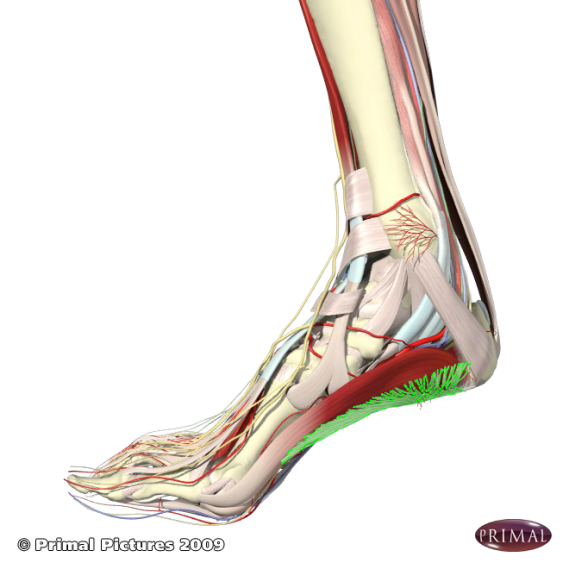 This is a common injury in sports involving running and jumping, and results from overuse and overloading of the plantar fascia. The function of the plantar fascia is to transmit forces through the foot and act as a spring assisting with shock absorption and propulsion during walking, running and jumping . Excessive use and loading can lead to microscopic tears within the substance of the plantar fascia. To repair these microscopic tears, the body commences an inflammatory response. Although this response is initially part of the healing process, when the stresses are repeated, the inflammation is prolonged and so produces local tissue damage. Factors that may contribute to plantar fasciitis include a recent change in training (e.g. frequency, duration, intensity, training surfaces), reduced rest periods between training, biomechanical abnormalities, poor footwear, and decreased muscle flexibility and joint range of motion. Anatomical dissection studies have shown continuous fibres running between the plantar fascia and the Achilles tendon. Since two large muscles in the calf attach to the Achilles tendon, excess tightness in the calf can also be a contributing factor to developing plantar fasciitis. These factors can lead to increased stress on the plantar fascia, microtears and subsequent inflammatory response.
How does it feel?
Plantar fasciitis results in pain typically located towards the under surface of the heel bone, but not exclusively. This pain typically develops gradually. Initially, it may only be painful following exercise. For example, it may be first felt on rising the day following participation. Associated with the pain may be stiffness or tightness in the sole of the foot. Typically, these initial signs of plantar fasciitis disappear quickly with walking about or after a warm bath. However, as you continue to participate, the pathology progresses and the pain within the plantar fascia becomes more intense and more frequent. For example, it may begin to be present during participation. In the early stages, this pain during participation may ease off as you warm up, only to return when you cool down. However, as you continue to participate, the pathology worsens and your pain may begin to be present for longer periods during participation until it is present all of the time. This may interfere with your performance. It is also common to experience pain on the first few step in the morning.
What should you do?
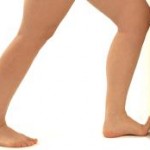
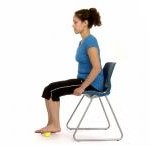
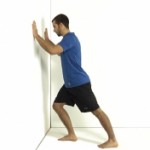
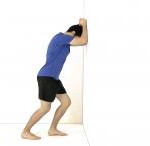
Plantar fasciitis generally doesn’t settle without assessment and medical care. If you have or suspect you have Plantar fasciitis, you should consult a musculoskeletal health professional (e.g. Physiotherapist or Sports Doctor). In the meantime, you can begin initial treatment. This should consist of icing and regular stretching of the calf muscles and the plantar fascia. Icing can be applied in the form of crushed ice in a moist towel for 15-20 minutes or alternatively ice massage can be applied by ¾ filling an empty plastic bottle, freezing it and the rolling your foot along the frozen bottle on the floor. Self-massage to the plantar fascia can also be performed by placing a golf ball or similar on the floor and firmly rolling the sole of your foot over the ball. The calf and plantar fascia can be stretched as shown below and held for around 30 seconds, repeated three times and can be done 2-3 times per day. Stretching should NOT be sore.
What shouldn’t you do?
If you suspect you have plantar fasciitis, you shouldn’t ignore the problem. Your pain may get better as you exercise; however, the exercise you are doing may be interfering with the healing process and causing further damage. This can lead to your injury getting worse such that your pain does not ‘warm-up’ and you feel it throughout participation. If this occurs, your recovery may be prolonged and it may take a number of months for you to return to full participation.
Management
The assistance of a sports injury professional is important in the treatment of Achilles tendinopathy. Initially, they can assist in the diagnosis of the problem and establishing its severity. From their assessment, the sports injury professional will determine an appropriate treatment plan. This may involve activity modification, soft-tissue treatment such as massage and stretching, correction of you biomechanics, taping and strapping, application of orthotic insoles and the progression through a series of specific rehabilitation exercises.
Disclaimer: This information is not a substitute for medical advice and you should seek professional advice from a doctor, physiotherapist or other healthcare professional.
What We Treat